


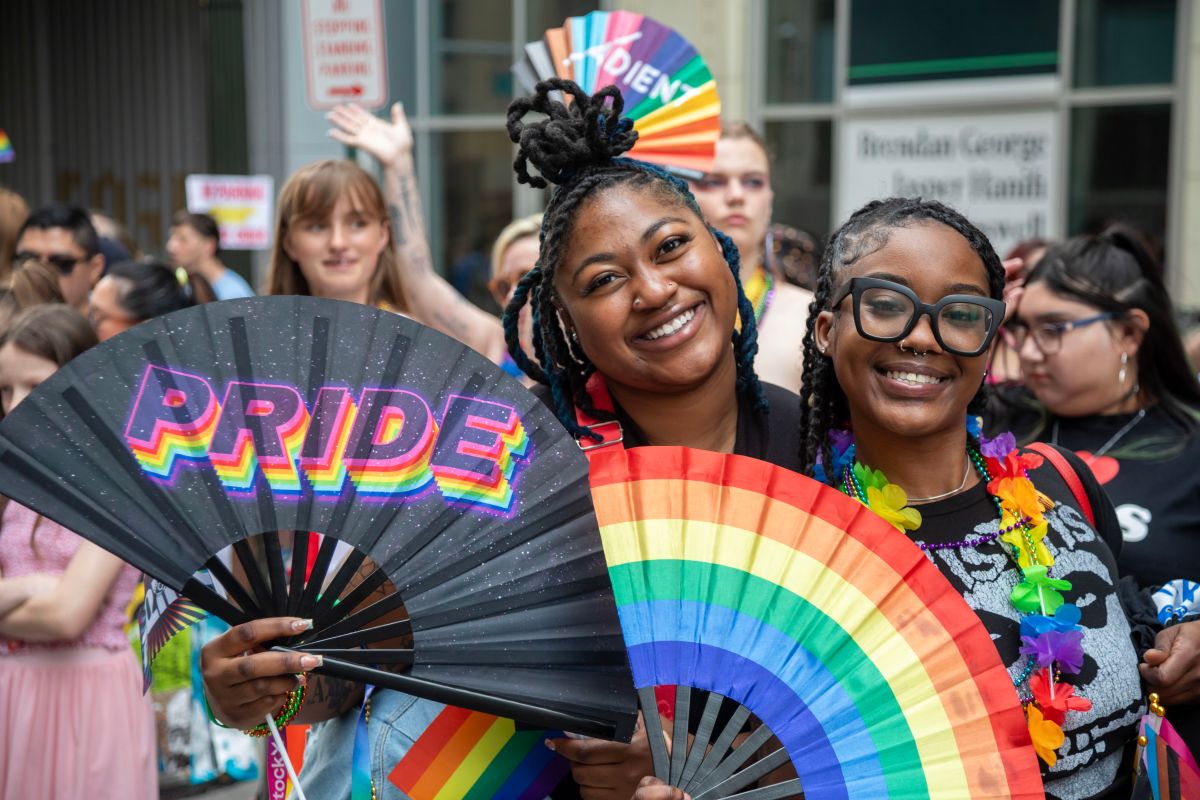
Tyona Jackson Wesley-Stitt still recalls the hot June day in 2008 when marchers swung from 25th and Adams Street onto Taft Street and claimed Gary’s first Pride parade, capping it with a family picnic at Marquette Park.
She had formed Rainbow Days, a local grassroots group, two years earlier, laying the foundation for what would become the city’s inaugural Pride parade. After a few years, however, LGBTQ processions through Gary’s streets have fallen silent. The flags, the music, the public joy — all of it has faded in time.
Yet, in recent months, messages of renewed interest have landed in her inbox, and Wesley-Stitt is beginning to wonder if it’s time to bring it all back.
“I feel like in Gary, we have such a diverse community, but I do feel like fear does hold a lot of people in our community back,” she said.
For years, Pride Month in Gary has slipped by without a parade or central celebration. In a city with a rich Black history and whose LGBTQ milestones are scattered and hard to trace, many LGBTQ residents say public visibility is still limited. They describe a culture shaped by fear, faith, and the lingering weight of stigma — forces that have limited local Pride efforts and pushed some to seek affirmation in neighboring cities instead.
While some hope to revive public celebrations, others are working to fill the gap online, using Facebook pages, podcasts, and YouTube channels to reach their community. They say every local gathering, whether virtual or in person, can be a lifeline that shows people they belong. Through events, outreach and storytelling, some are trying to rebuild something that once felt possible in Gary — and still might be.
Northwest Indiana Rainbow Days kept the parade going for several summers until 2011, when internal disagreements over planning and control slowed momentum, Wesley-Stitt said. After the disappointment of the infighting, along with what she sensed was waning support in the community, Wesley-Stitt decided to step away from both the march and the organization she had built.

“It was very joyful,” she said of those early years. “I just wanted to have a space for families and those who support us.”
Reflecting on that time, Wesley-Stitt said she wanted to give Gary residents the kind of celebration they might travel to Chicago to experience, but grounded in their own streets and surrounded by their own community.
“As someone who was born and raised in Chicago, I know how big that parade has gotten, but I also realized that it’s easy to disappear in that crowd,” she said. “It’s a wonderful thing, but I wanted something centralized in our area. I didn’t know where to start, so I started from the ground up.”
The parade’s absence has left a gap that residents are now trying to fill in quieter ways.
Sara Pufahl has lived in Gary long enough to see the impact of not having an active LGBTQ events space in the community. Seeing more events in Porter County and other surrounding counties caused her to start a Facebook page dedicated to sharing events for Gary and Lake County residents.
LGBTQ NWI features events within three hours of Northwest Indiana, whether that be in Chicago or other cities in Illinois, Michigan, or other drivable locations
“The rights of our community are at stake,” she said. “We have had to fight for our right to dress how we want in public, to love how we want in private, to live the way we were born to live on this earth.”
A 2023 study by the Williams Institute at the UCLA School of Law estimated that LGBTQ people make up 5.4% of Indiana’s population and that the Midwest accounts for about 21% of the nation’s LGBTQ community. Another study found that 1.21 million adults identify as both Black and LGBTQ, with 18% living in the Midwest.
“Pride started as a riot — it is a statement that the LGBTQ+ will not go back to the closet or hide in the shadows,” Pufahl said. Community, she added, is a necessity.
“Attending LGBTQ events helps to save lives because it reaffirms that a person belongs in this world and there is a way to find joy in being their authentic self,” Pufahl said.
Pufahl is not alone in trying to fill the silence left behind. Others, like Lisa Bennett, have turned to storytelling.
Bennett, a Gary native, performed and spoke at this year’s NWI Pride in Lake Station. The two-day festival raised money for the Indiana Youth Group, which supports LGBTQ youth across Northwest Indiana. Bennett and her wife, Rasheida, recorded live episodes of their podcast during the event.
She remembers the 1970s and ’80s, when she said few in Gary felt safe being open about their identities. People would sneak to Hammond to go to a bar called The Depot and other safe spaces in the community to be themselves.
She said she didn’t start to feel comfortable in her sexuality until she left for college in Rochester, New York, where there was a large mixed gay community. Not experiencing that in Gary, there she found a big support network for building a thriving community, marriage, and other aspects.
“I grew up in a church with my family that was pretty well indoctrinated in church,” she said. “I have a huge extended family, and they all were supportive to me, but I never wanted to take the risk about what it meant for them if I came out and I’m gay.”
It wasn’t until she got married in 2005 and matured more as an adult that she stopped asking for permission to live her life.
Returning to Gary to help family members who fell ill and needed assistance, she sought a home within the local church community.
“I don’t know if it’s because it’s Northwest Indiana, or because we are still in the Bible Belt of Indiana, or it’s because it’s Gary, which is predominantly African American,” she stated on the struggle of coming back into the community as a queer person. “In African American tradition, we have a tougher time accepting people who are a part of the rainbow family than other cultures.”
Bennett said she’s always had a connection to religion, and she wouldn’t allow her sexuality to be used to build hate against her. That’s what led to the creation of her podcast and YouTube channel, Lisa and RaSheida, which the couple uses to share affirming stories and reach LGBTQ youth.
“We have to step out here and allow them to see us, and we have to do it because there are some kids who are lost and who don’t have the support,” she said.